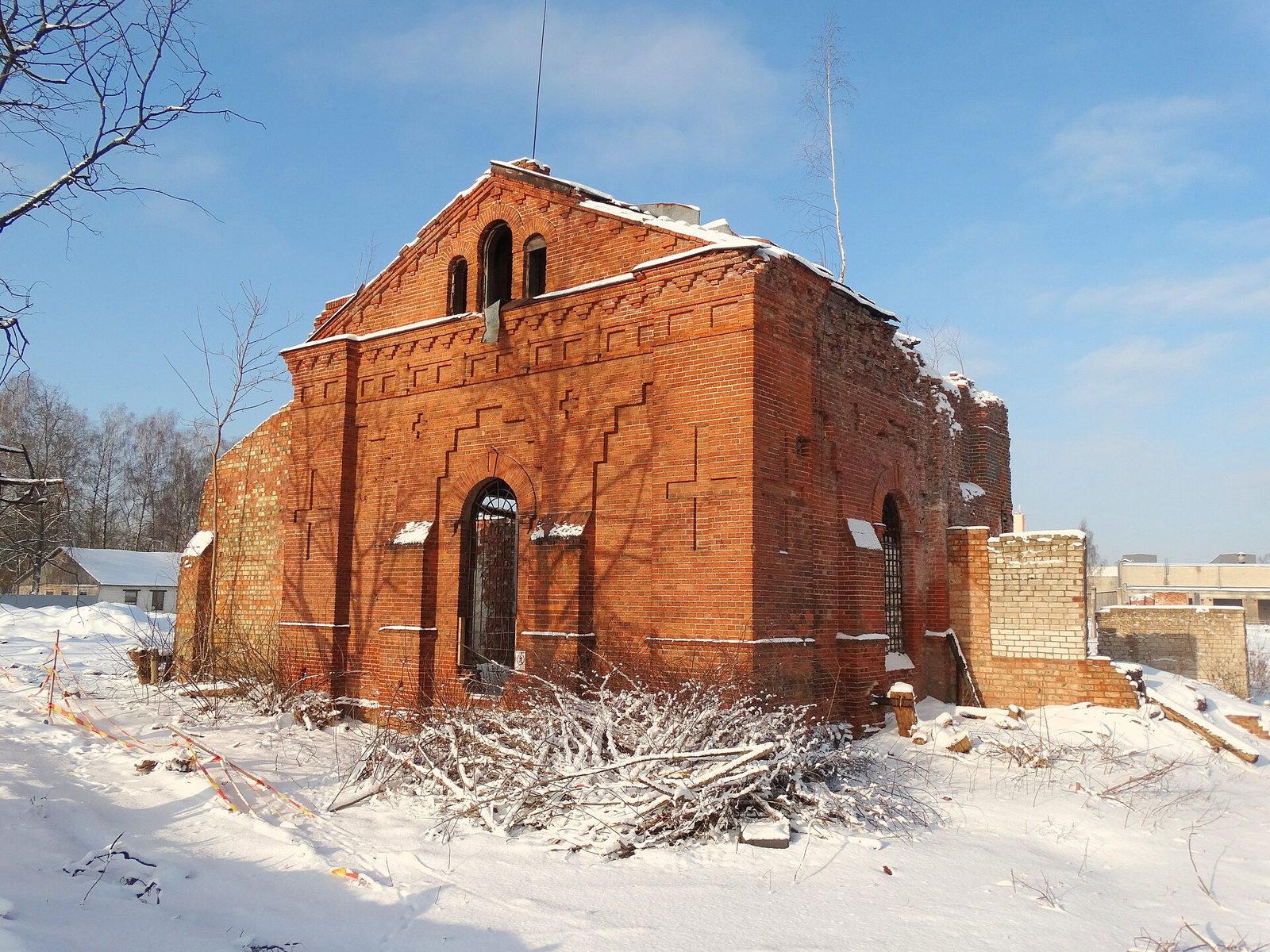
The church on Radvilėnų plentas in January 2019. Photo: Vilensija, CC BY-SA 3.0, Wikimedia Commons
On Radvilėnų plentas in Kaunas, between blocks of flats and a new police building, stand the red-brick remains of a church. Crosses are still moulded into its walls. It was built for the soldiers of an empire, became the church of a Lithuanian cavalry regiment, spent the Soviet decades as a car repair workshop and then slowly fell apart. In July 2023 it was sold at a public auction, listed, rather sadly, as a "garage-workshop building".
This is the story of the Church of the Transfiguration in Žaliakalnis, one of the strangest and most touching heritage sales in Lithuania in recent years. It is drawn from the reporting of Lrytas, which spoke to the buyer, the seller and the heritage authorities after the auction.
A church for a fortress
Kaunas Fortress was built between 1882 and 1915, and it had six Orthodox churches. In what is now Žaliakalnis, the Russian army set up a military town, and at the end of the 19th century the 3rd Novorossiysk Dragoon Regiment was stationed there. Almost all the barracks were wooden. Only the church and a few service buildings were brick.
The regimental church opened in 1904 in an extension of the squadron canteen. It could hold about 200 people. Next to it, and joined to it, was a riding hall big enough for two to three thousand soldiers.
Oaths and hussars
Between the wars the military town became home to the 1st Hussar Regiment of the Grand Hetman of Lithuania Jonušas Radvila, a light cavalry regiment of the Lithuanian army, and the building was used as a Catholic church. It was more than a place to pray. New recruits swore their oath to defend Lithuania there. In 1930 the wooden barracks were replaced with brick ones, with running water, drainage and central heating. A mosaic by the artist Zenonas Kolba decorated the church's pediment.
Workshop, fire and ruin
In Soviet times the church became a car repair workshop and the riding hall a canteen. For many years after that the building was neglected and vandalised, its bricks were stolen and it burned more than once. The building it was joined to has not survived.
Konstantin Pankrašov, a deacon of the Orthodox cathedral in Kaunas, remembers walking past it every day on his way to school. Even then, he told Lrytas, nobody looked after it.
Protected, but fragile
In 2014 the surviving fragments were entered in the Register of Cultural Property (code 37608) with local significance, and the register lists their valuable features: corner pilasters with recessed crosses, fragments of the main walls, arched window openings, columns, a dentil cornice and geometric brick decoration. The site also lies in the visual protection subzone of the Žaliakalnis historic area. A team at Kaunas University of Technology has surveyed the ruin with drones and built a 3D model of it.
The protection is real. "In the territory of the fragments of the Church of the Transfiguration it is forbidden to destroy or otherwise damage the authenticity and valuable features of the heritage object and its surroundings," Sabina Strazdienė, a chief specialist at the Kaunas office of the Department of Cultural Heritage, told Lrytas. Under Lithuanian law the owner is responsible for maintaining a protected property.
The auction
In July 2023 the state company Turto bankas sold the church fragments with a 24.28-are plot at a public electronic auction. The listing described a "garage-workshop building" of 82.48 m², in an emergency condition with 18% of the building surviving, and noted that it was a heritage object. The plot falls in a zone for high-density housing under the Kaunas master plan.
The starting price was €188,561. Two bidders took part, and after active bidding the winner bought it for €312,000 (auction sale price, according to Turto bankas). Registrų centras records show that UAB Soliris, a Kaunas oil and lubricant supplier, acquired the building and plot on 13 July 2023.
Its manager, Linas Sologubas, was candid. "We have no plans for now. We are looking into the situation. It may even be that we sell the plot. We haven't decided, we don't have a vision," he said.
Two ways to save it
Vladimir Orlov, who leads the garrison of the Kaunas Fortress VII Fort, sees two options: bring back the building's historic function, or give it a new one, as happened at the VII Fort, where the old barracks now house a school. He was frank that a new use is hard to make pay for a building this small and this damaged, with no windows, doors or heating.
He also pointed out how such churches came to exist in the first place. Officers would pool money from their pay, some of them with family estates behind them. "Are there wealthy people now who would agree to take three or four thousand euros out of their pockets and chip in to have a chapel?" he asked. "If the new owners preserve the Church of the Transfiguration in Žaliakalnis, they will help keep what makes Kaunas unique."
Deacon Pankrašov was less hopeful about the Orthodox community rebuilding it themselves. "It would be a miracle if someone rebuilt it," he said. (Quotes translated from Lithuanian.)
We have not found any public announcement of plans for the site since the sale. If that changes, we will update this story.
What this sale tells buyers
Read the listing for what it is. The auction notice called it a garage-workshop. The Register of Cultural Property called it a protected church. Always check a property's code in the public register at kvr.kpd.lt before you bid.
Protection travels with the building. Whoever owns it must keep its authenticity and valuable features, and cannot simply clear the plot, whatever the master plan says about the land.
A ruin can still draw competition. Two bidders pushed the price about 65% above the start. Rare sites with a story attract people, even when the building itself needs everything.
This church also appears in our roundup of historic Baltic properties that found new owners, and you can see remarkable historic properties for sale right now. If you own a property with a past like this one, it belongs in our historic and heritage section.
Sources
- Lrytas, "Neliko turtuolių, kurie koplytėlei sumestų po 3-4 tūkst. eurų: cerkvė Žaliakalnyje jau turi naujus šeimininkus", 5 September 2023 (in Lithuanian)
- Kaunas University of Technology, Digital heritage: 3D models of heritage objects (in Lithuanian)
- Register of Cultural Property (kvr.kpd.lt), unique code 37608