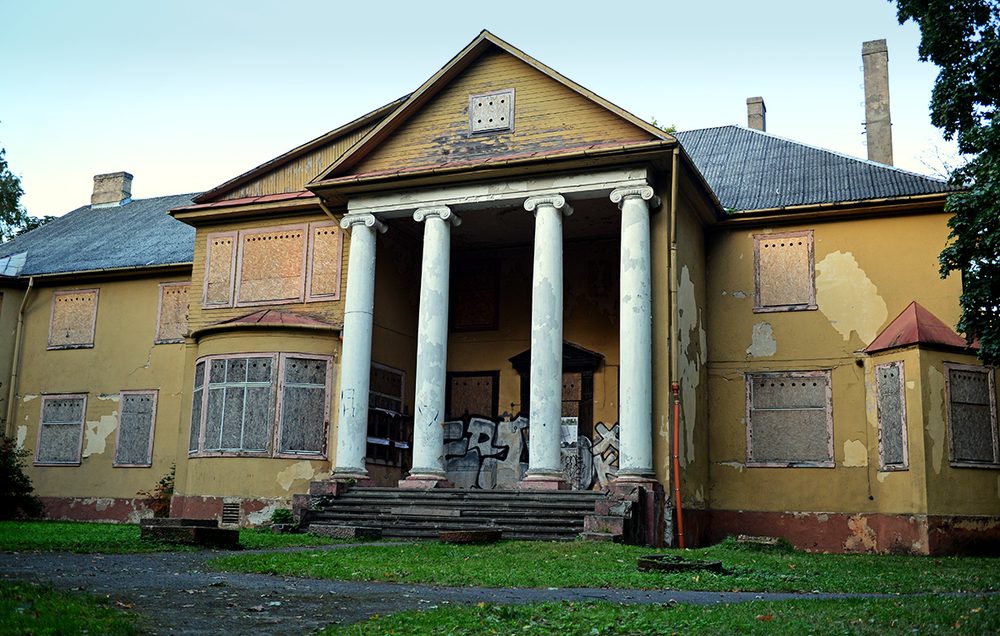
Majori Manor, Jūrmala (2017). Photo: Forestermax, CC BY-SA 4.0, Wikimedia Commons
Every so often a building with a real past comes up for sale in Lithuania, Latvia or Estonia. It might be a manor first mentioned in medieval chronicles, a church that spent the Soviet decades as a car repair workshop, or a town house in Old Rīga that has stood since the 17th century. Most of these properties are sold by the state, through public auctions run by Turto bankas in Lithuania, VNĪ (State Real Estate) in Latvia and RKAS in Estonia. Their results are published, so the prices are public.
We went back through the original announcements and news reports and picked eleven sales from the last few years that are worth telling. Every price below is labelled for what it is: an auction sale price, a starting price or an earlier asking price. The source for each one is named in the text and listed at the end.
Lithuania
A pastor's house in the heart of Klaipėda (H. Manto g. 37). The house on H. Manto gatvė was built in the late 19th century as a home. In the early 20th century it was lived in by Vilius Gaigalaitis, the Lutheran pastor and cultural figure of the Klaipėda Region, which gives it memorial value. Much later it was used for offices. In March 2025 Turto bankas sold the premises in the building that had housed the Klaipėda District Court at a public auction. The auction sale price was €652,050, and bidding pushed the final price up by nearly 47%, according to the Turto bankas release published by 15min. The house sits in Naujamiestis, a short walk from the Old Town.
A fortress church in Žaliakalnis, Kaunas (Radvilėnų pl. 1A). This is the most fragile property on the list, and one of the most moving. The Church of the Transfiguration was set up around 1904 as the regimental church of a military town of the Kaunas Fortress. Between the wars it was used as a Catholic church by a Lithuanian hussar regiment, and new recruits swore their oath there. A mosaic by the artist Zenonas Kolba decorated the pediment. In Soviet times it became a car repair workshop, then stood empty for years, burned more than once and lost many of its bricks. The surviving fragments were entered in the Register of Cultural Property in 2014 at local significance level. In July 2023 Turto bankas auctioned the fragments with a 24.28-are plot, listed rather sadly as a "garage-workshop building". The starting price was €188,561. Two bidders took part and the auction sale price was €312,000, Lrytas reported. The buyer, UAB Soliris, said at the time that it had not yet decided what to do with the site.
A Radziwiłł-era stud farm at Buivydiškės, Vilnius district. Just 7.5 km from the centre of Vilnius, the Buivydiškės manor estate was held for centuries by the Radziwiłł family. Inside the estate stand a riding hall, stables and a smithy with about 1,600 m² of floor space, on a leased plot of more than one and a half hectares beside the Sudervė stream and one of the estate ponds. The neighbouring park is thought to be one of the oldest terraced parks in Lithuania, begun in the 17th century. Turto bankas sold the complex at auction in summer 2025. Three bidders kept raising their offers until the last minute, and the auction sale price rose from a starting price of €510,000 to €765,000.
A former fisherman's house in Neringa. Neringa, on the Curonian Spit, is part of a UNESCO World Heritage site, and property there is often seen as cultural inheritance. In July 2025 a former fisherman's house on Skruzdynės gatvė sold at a Turto bankas auction for €1.35 million. The buyer, Andrius Valatka of the company Padarom, told Turto bankas he decided to bid after walking past the building and seeing the "for sale" sign. His first plan is cultural events, and he says the house should keep its distinctive character. The Turto bankas release does not state the building's own register status.
Kalnaberžė manor, Kėdainiai district. Kalnaberžė is first mentioned in the chronicles of the Teutonic Order in 1371. The manor homestead is in the Register of Cultural Property, and a park laid out in the mid-19th century surrounds it. The complex includes the main palace of about 507 m², the remains of a school building, two farm buildings and a cellar, with a leased plot of 13.7 hectares. The state had taken the manor back from private owners who had not looked after it, and work on the palace roof and façades began in 2017. In September 2022 Turto bankas found a buyer at the very first auction. The starting price was €53,700; two bidders joined in the final minutes, and the auction sale price was 73 thousand euros, as Turto bankas reported it.
Latvia
Majori Manor, Jūrmala. Majori Manor was built in 1910 to a design by the architect W. Bockslaff, as a summer residence and hunting lodge for the von Fircks family of Courland. It stands on the bank of the Lielupe on a plot of 23,845 m². After the 1920 land reform it passed to the state, and from 1924 until December 2006 it housed an orphanage. It is a local architectural heritage site. The repeat auction ended on 27 June 2024: the starting price was €315,084.97, four bidders took part, and the auction sale price was €699,084.97, according to VNĪ. VNĪ hoped it would become a hotel or homes.
Pils iela 21, Old Rīga. The house at 21 Pils Street was built in 1698 and has a total area of 1,163 m². It was heavily altered in the 19th century and became a vocational school after 1945. It belonged to the Latvian state through the Ministry of Foreign Affairs and is on the list of state-protected cultural monuments. VNĪ sold it at a re-auction with a single bidder, a company it did not name. The starting price was €1.035 million and the auction sale price was €1.045 million, LSM reported on 30 September 2025.
Īle sanatorium, Dobele municipality. Īle is a whole manor centre: castle, park, stables, laundry house and inn from the 19th and early 20th centuries, plus a director's house, sunroom and office from its sanatorium years in the 1920s and 1930s. The property covers 23 hectares, including 14.4 hectares of forest, with 22 buildings, among them cultural monuments of national and local importance. At the VNĪ auction on 21 April 2023 three bidders went through 131 bidding steps. The starting price of €88,200 rose by 74% to a winning bid of €153,700, with the purchase contract to follow once the buyer had paid.
Mālmuiža, Gulbene municipality. Mālmuiža took patience. The manor house was built in the late 19th and early 20th centuries, with a brick ground floor, wooden upper storey and roof, and fine carved wooden details around the windows and cornices. Part of the property is registered as a local architectural monument. With 10.1 hectares and seven buildings, it sold at a VNĪ repeat auction for €48,980 in August 2023.
Estonia
Liberty Manor, Tallinn. Liberty summer manor in Rocca al Mare first appears on a map from 1783. It belonged to the Koch family, and the 3.6-hectare seafront site includes Egon Koch's wooden summer villa, still close to its original form with grooved walls and a coffered ceiling, the Daheim log house with its original fireplace, and the foundation of Egbert Koch's villa. In 2013 it was separated from the Estonian Open Air Museum so it could become a presidential residence, a plan that never went ahead. In September 2024 RKAS auctioned it with a starting price of €890,000. Five bidders kept the auction running well past its 2 p.m. deadline, and it closed after 4:30 p.m. at an auction sale price of €2.62 million excluding VAT, ERR reported. The sale came with a condition: the new owner must rebuild Egbert Koch's villa on its original site, in its original volume and appearance, by the end of 2027.
Maardu Manor, Harju County. The Bank of Estonia bought Maardu Manor in Maardu village, Jõelähtme municipality, in 1993. The complex has five historic buildings and a manor park with old trees, and it belonged in turn to several well-known Baltic German families. The bank first offered it in February 2015 with an asking price of €2 million, lowered the asking price to €1.5 million a year later, and returned it to the market in 2024 at €1.05 million. An auction in 2025 opened at a starting price of €700,000. In July 2025 ERR reported that the manor had been sold for €851,000 to Autokanal OÜ. "You could definitely say 'finally'," said the bank's governor, Madis Müller.
What these sales have in common
Most of these buildings were sold by state bodies that no longer needed them, and most went through public auctions whose results are published. Several needed a second auction, or years on the market, before the right buyer appeared. Others drew several bidders who kept going until the last minute. The difference usually has less to do with the price than with whether someone can see a future for the building: a hotel, a home, a cultural venue, or simply a careful restoration.
What buyers should know
Heritage property comes with duties as well as history, and the rules differ in each country. In Lithuania, check the property in the public Register of Cultural Property (kvr.kpd.lt) first. Under the new version of the Law on the Protection of Immovable Cultural Heritage, in force since 1 November 2026, the seller must tell the municipality in writing at least one month before the sale. The municipality checks whether the condition of the property matches the register, and the property can only be handed over while that check report is valid (six months, in most cases). The owner must look after the property and its valuable features, and state and municipal programmes can fund part of the works, up to 80% in some cases. In Latvia, the state has a right of first refusal when a cultural monument of state significance is sold, and the National Heritage Board decides whether to use it. In Estonia, the sale contract for a monument must refer to the act that put it under protection, and conservation or restoration work needs a permit. This is general information, not legal advice, so talk to the local heritage authority and a lawyer before you bid.
Own a property with a story?
If you own a historic manor, a former church or a building people still talk about, it belongs in Live Baltic's historic and heritage section. There, properties like these are presented with their history, their heritage status and the facts serious buyers ask for first. Owners and agents can write to us at agencies@livebaltic.com, and we would be glad to hear about yours.
Sources
- 15min.lt, Turto bankas press release, 25 Mar 2025: H. Manto g. 37, Klaipėda
- Lrytas, 5 Sep 2023: Viešpaties Atsimainymo cerkvė, Radvilėnų pl. 1A, Kaunas
- Turto bankas, 4 Jul 2025: Buivydiškės stud complex, Vilnius district
- Turto bankas, 14 Aug 2025: former fisherman's house, Neringa
- Turto bankas, 22 Sep 2022: Kalnaberžė manor, Kėdainiai district
- VNĪ (Valsts nekustamie īpašumi), 27 Jun 2024: Majori Manor, Jūrmala
- LSM (Latvian Public Broadcasting), 30 Sep 2025: Pils iela 21, Rīga
- VNĪ, 25 Apr 2023: Īle sanatorium, Dobele municipality
- VNĪ, 21 Aug 2023: Mālmuiža, Gulbene municipality
- ERR News, 26 Sep 2024: Liberty Manor, Tallinn
- ERR News, 17 Jul 2025: Maardu Manor, Harju County
- Laws: Lithuanian Law on the Protection of Immovable Cultural Heritage (version from 1 Nov 2026); Latvian Law on Protection of Cultural Monuments, Section 8; Estonian Heritage Conservation Act (RT I, 12.07.2025, 20), §§ 37 and 52