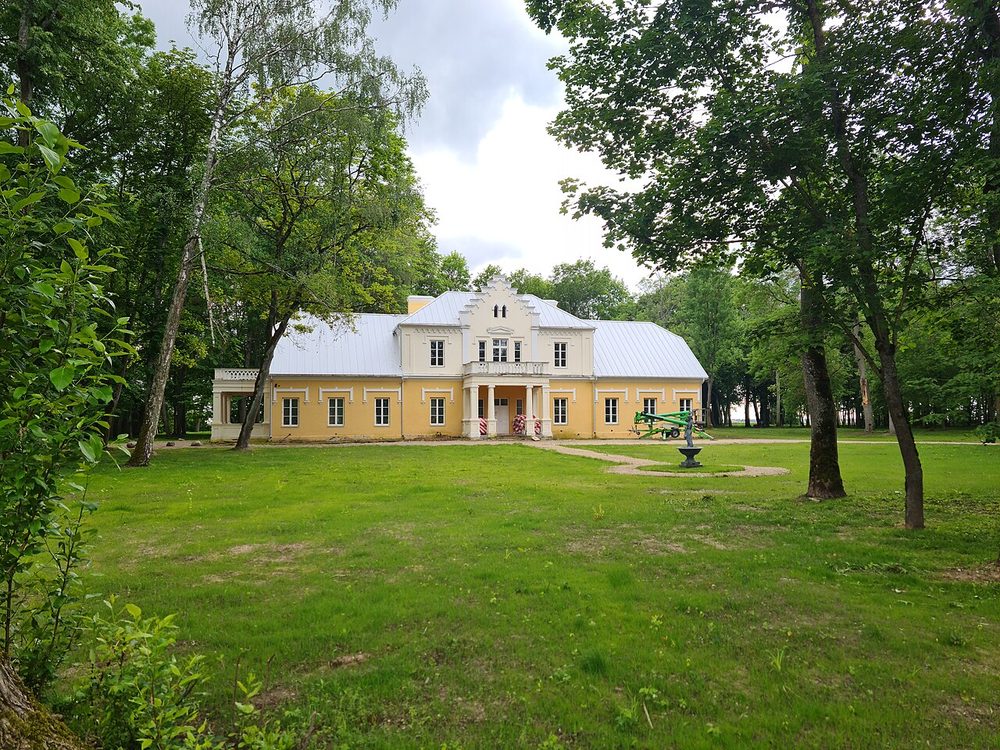
Kalnaberžė manor homestead, Kėdainiai district (2024). Photo: TautvydasSiburkis, CC BY-SA 4.0, Wikimedia Commons
Twelve kilometres north-east of Kėdainiai, on the right bank of the Nevėžis, a neo-Gothic manor house stands in a park of old limes, oaks and maples. From 1869 a boy called Pyotr Stolypin spent his childhood here. He later became Prime Minister of the Russian Empire, and five of his six children were born in this house. A century later it was a ruin with no roof.
In September 2022 the Lithuanian state sold it at auction. The story of how it got there, and what its new owners are doing with it, says a lot about buying heritage property in Lithuania.
Six centuries in one estate
Kalnaberžė first appears in 1371, in the chronicle of Hermann von Wartberge, when the Livonian Order raided the middle Nevėžis. In the 17th and 18th centuries the estate belonged to the Radziwiłłs, who used the house mainly for hunting. In the 19th century it passed to the Counts Czapski.
After the 1863 uprising, Count Eduard Czapski was exiled to Siberia for funding the rebels and his estates were confiscated. Kalnaberžė went cheaply to a Russian general, Sergei Kushelev. Local histories say he lost it at cards in 1868 to another general, Arkady Stolypin (the Lithuanian encyclopedia VLE dates the sale to Stolypin to 1882). Arkady built the palace that survives today. His son Pyotr inherited it, rebuilt it in the neo-Gothic style and spent his summers here with his family. In 1910 the house had a telephone and a telegraph line, ministers came to visit, and hundreds of guards were posted nearby. In 1911 Stolypin left Kalnaberžė for Kyiv, where he was shot.
In 1924 the poet Kazys Binkis bought the manor centre with nine buildings and 70 hectares. He could not pay his debts and handed it over to the Ministry of Justice. In 1925 it became Lithuania's first institution for juvenile offenders, a colony for boys. After the war it was a children's home, then a boarding school from 1959, and later the offices of the local collective farm.
Neglect, a court case and an auction
In 2001 a company called Lukta, then controlled by the politician Viktor Uspaskich, bought the manor for 12,000 litas. Nothing was done, and the building fell further into ruin. The heritage authorities went to court, and at the end of 2012 the Panevėžys Regional Court ruled that the manor should pass to the state. "As much as there were valuable surviving elements and details, they have decayed," a specialist at the Department of Cultural Heritage told tv3.lt in 2025.
From 2017 the state repaired the roof and the façades. Then Turto bankas, the state property company, put it up for sale. The complex it offered was five structures: the main palace of almost 507 m², the remains of a school building of 982 m², two farm buildings of 495 m² and 570 m², and a 72 m² courtyard cellar, with a leased plot of 13.7 hectares and the mid-19th-century park around it. The manor homestead is in Lithuania's Register of Cultural Property.
The auction took place in September 2022. Two bidders waited until a couple of minutes before the end before they started. Starting price: €53,700. Auction sale price, as Turto bankas reported it: €73,000. The manor found a buyer at the very first auction. Turto bankas noted that manor auctions usually draw few bidders, because every manor has to find a buyer with a vision for it.
The family who took it on
The auction buyer did not keep it for long. Marius Šiburkis, a construction engineer and property developer from Kaunas, and his wife Inga, an architect, heard that an acquaintance had just bought Kalnaberžė and was looking to sell it on. They drove out to see it. "Others saw only problems they could never solve here," Marius told the local paper Kėdainių mugė. "We, the dreamers, saw a vision of how this place could come back to life." Their son Tautvydas came on the second visit and gave his verdict: there were probably good things hiding under all that undergrowth.
Even then it was not simple. After the deposit was paid, the seller came back to say another buyer was offering more. That buyer changed her mind, and the seller admitted he felt as if he had lost the manor at cards. The family took it over at the start of 2023. (Quotes translated from Lithuanian. The price they paid has not been published.)
Work began in spring 2023, mostly outside. They cleared the 13-hectare park, pulled out stumps, levelled the ground and sowed a tonne of grass seed. They cleaned out the ponds, found their own water in the old well and brought in electricity. Inside, very little original material survived. "We found what you see," Tautvydas said: a few door frames, bare walls, no ceilings, and a few old stove tiles they may use to rebuild some of the stoves. Under later layers they uncovered a fragment of wall decoration from Stolypin's time.
In July 2025 ILTE, Lithuania's national development bank, lent the project just over €500,000 under its "Paveldas" heritage loan, with 30% covered by a grant. The total investment is over €700,000, and the plan runs for 24 months. The renewed manor is meant to have a public events space, two halls for workshops and community use, a small museum about the people who lived here, six guest rooms and a self-service café. The palace was due to close in mid-May 2025 for the final inside and outside works, which the family planned to finish by the end of 2026. The park stays open to walkers, and the owners say there will never be a "private property" sign.
What this sale tells buyers
Price is only the entry ticket. The manor sold for €73,000. The total investment in its renewal is more than €700,000, nearly ten times as much, and it relies on a heritage loan and a grant.
Protection stays with the building. Kalnaberžė went back to the state because an earlier owner did not look after it. A protected property comes with a legal duty of care, and the heritage authorities do go to court.
Heritage sales often happen in two steps. The first auction buyer sold it on within months. If you are interested in a historic property, the auction is not the only moment to buy.
Expect very little original inside. Decades as a school, a children's home and offices took most of the interior. Check the register entry at kvr.kpd.lt (Kalnaberžė's unique code is 215) and visit before you bid.
You will also find Kalnaberžė in our roundup of historic Baltic properties that found new owners, next to historic properties for sale right now. If you own a manor, a church or another building with a past like this one, it belongs in our historic and heritage section.
Sources
- Turto bankas, "Kalnaberžės dvaras turės naujus šeimininkus", 22 September 2022 (in Lithuanian)
- Kėdainių mugė, "Kalnaberžės dvaro renesansas: Šiburkių šeima kuria vieną unikaliausių vietų Lietuvoje", 24 January 2025 (in Lithuanian)
- Kėdainių mugė, "Kalnaberžės dvaras kviečia į svečius", 28 April 2025 (in Lithuanian)
- BNS Spaudos centras, "Kalnaberžės dvaro atgimimui – ILTE paskola", 2 July 2025 (press release, in Lithuanian)
- tv3.lt, 13 July 2025 (in Lithuanian)
- L24.lt, "Radvilas, P. Stolypiną ir K. Binkį menantis Kalnaberžės dvaras vėl atgyja", 21 January 2024 (in Lithuanian)
- Visuotinė lietuvių enciklopedija, "Kalnaberžė" (in Lithuanian)
- Kėdainiai Tourism and Business Information Centre, "Kalnaberžės dvaras ir parkas" (in Lithuanian)
- Register of Cultural Property (kvr.kpd.lt), unique code 215